Both countries will advance maritime security and strengthen disaster response in the region, says Modi.
Sharma proposes to pass on the 'handover note' to his successor, which as per the poll projections is likely to be from Bharatiya Janata Party-led National Democratic Alliance.
The agenda prepared by ministers will be discussed by Prime Minister Narendra Modi and other RCEP leaders in Nonthaburi, a city north of Bangkok, on November 4, the official deadline to close talks.
Prime Ministers Modi and Abe enjoyed a close and empathetic relationship and this certainly gave a sustained momentum to the India-Japan strategic partnership. It is necessary for India to reach out and engage with his successor as early as possible, advises former foreign secretary Shyam Saran.

Prime Minister Narendra Modi said on Monday that the partnership between India and Germany could serve as an example of success in a complex world as the two sides inked several agreements focused on sustainable development under which India would receive USD 10.5 billion assistance by 2030 to boost the use of clean energy.
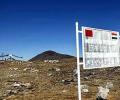
Prime minister likely to visit Beijing, Shanghai; also President Xi's home province, Shaanxi. Nayanima Basu reports
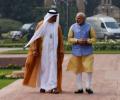
Terming his discussions as 'fruitful and productive', Modi said the discussions were wide ranging, covering the entire spectrum of the bilateral engagement.

The two countries also signed three other agreements -- to enhance aviation links, to jointly work in the area of energy efficiency and promotion of parliamentary cooperation.

It became increasingly clear that the real negotiations the government had to conduct were with Indian business which was wary of yet another free trade agreement, points out T N Ninan.

India will look to play a key role in the APEC, EU and Africa regions to increase its competitiveness.

Modi will have a number of high-profile multilateral and bilateral meetings with global leaders including United States Vice President Mike Pence and Singapore premier Lee Hsein Loong.

The agreement on services, if ratified by all member countries, could prove to be a game changer for Indian professionals in education, healthcare & IT.
India will have to show more willingness to import, and since Biden will not encourage sale of oil and gas to bridge the gap, it means there has to be more meaningful duty reduction in other areas even if Delhi baulks at a Free Trade Agreement so soon after walking out of RCEP.
'It seems a wiser decision to pull out at the right moment than regret after joining the pact,' explains Dr Rahul Mishra.
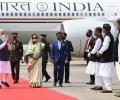
The South Asian nations could script a new history of cooperation and prosperity that could serve as an example for other nations, notes Dr Rahul Mishra.

Prime Minister Malcolm Turnbull's first State visit to India is an indication of the success of India's Act East Policy, says Dr Rahul Mishra.
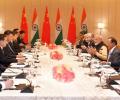
China had been trying hard to enter the Indian market, without opening its own to Indian products. There is an economic crisis in India-China relations that the Chennai Connect barely scratched the surface, points out Srikanth Kondapalli.
The success of the Bali Ministerial meeting of the World Trade Organisation in the first week of December in 2013 will mean that in 2014 countries will identify areas for early conclusion so that within the next two years, the Doha Agenda of the WTO -- which has remained in a limbo for long -- can be concluded.

It is often said that the India-Indonesia relationship is overshadowed by mutual neglect.
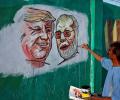
Existing trade deals, especially the 2009 pact with the Asean bloc, have been panned by the Centre for not boosting exports but flooding the domestic market with cheap imports. Subsequently, New Delhi has called for reviewing FTAs with Japan and South Korea. Going by that, a trade deal with the US is unlikely to be beneficial, say experts.

At the summit, India signed the SCO's memorandum of obligations, kick-starting the process of its accession into the group as a full member.

Modi said the two countries should resume their discussions on Comprehensive Economic Partnership Agreement.

'The two sides agree to continue firmly supporting each other in safeguarding their respective core interests,' a joint statement issued at the end of Muizzu's talks with Chinese leaders said.

Prime Minister Narendra Modi's opinion piece in Canada's The Globe and Mail focuses on commercial cooperation in the civil nuclear energy sector.
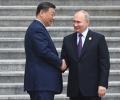
"The two sides note that the relationship between Russia and China has progressed to a more advanced interstate cooperation compared to the military-political unions of the Cold War era as it is not bloc or confrontational in nature, nor does it target any third countries," Russia's new agency Tass quoted the document as saying.
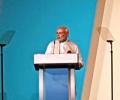
"In the flux and transition of our times, the most critical need in this region is to uphold and strengthen the rules and norms that must define our collective behaviour," he said.
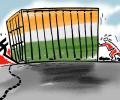
India needs a National Trade Policy Council, chaired by a minister who reports directly to the PM, says Jayanta Roy, former economic advisor to the Union commerce ministry.

The two leaders discussed the Ukraine crisis and several regional and global issues including increasing trade relations and cooperation in the field of mitigating the impact of climate change during their bilateral talks at the Danish Prime Minister's official residence in Mareinborg near Copenhagen.

Prime Minister Narendra Modi has met his Australian counterpart Scott Morrison in Washington, DC, ahead of the first in-person Quad meeting to be hosted by US President Joe Biden and discussed a broad range of issues of bilateral, regional and global importance, including the Indo-Pacific.

PM indirectly referred to North Korea's proliferation linkages with Pakistan.

Reflecting growing congruence in ties, India and Sri Lanka on Tuesday held extensive talks on sticky fishermen issue, ensuring justice to Tamils and ways to deepen trade and defence engagements besides resolving to intensify cooperation in combating terror and securing the maritime neighbourhood.
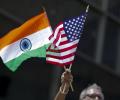
India has demanded resumption of export benefits to certain domestic products under GSP, and greater market access for its products from sectors like agriculture, automobile, auto components and engineering. On the other hand, the US wants greater market access for its farm and manufacturing products, dairy items and medical devices, data localisation, and import duties cut on some ICT products.

Both India and South Korea will use President Park Geun-hye's visit to unveil a comprehensive programme for mutual benefit and impacting on regional security environment, says Srikanth Kondapalli.
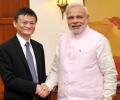
Alibaba's pervasive economic and social influence in China is seen as a threat to the authority of the Chinese Communist party, notes Shyam Saran.
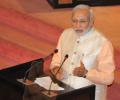
Modi strongly pitched for enhanced cooperation in key areas of maritime security and counter-terrorism.

Their favourite alternatives: Malaysia, Vietnam and the Philippines. Note, India is missing from that list. And this is despite an attractive financial incentive scheme for OSAT players. The reason, said a senior executive of a US chip company who had a meeting in Taiwan just a few weeks ago, is that "they want more predictability in government policy because they plan to put in big money."

Trade between India and Indonesia stands at $20 billion.

Whether it is Sri Lanka, Maldives, or Nepal, quietly but steadily, India has been reclaiming some of the ground it had lost to China, observes Aditi Phadnis.

Xi will attend the second informal meeting with Modi at Mahabalipuram near Chennai from October 11 to 12 and pay a state visit to Nepal on October 13, Foreign Ministry spokesperson Hua Chunying announced on Wednesday.

Mr Prabhu has a big challenge ahead in implementing trade reforms to regain the lost export momentum, says Jayanta Roy.
 © 2026 Rediff.com - Advertise with us - Disclaimer - Privacy Policy - Sitemap - Feedback - About us - Terms of use - Grievances